Introduction
At the turn of the twentieth century, Edmonton was just another Hudson's Bay Company (HBC) town in the District of Alberta of the North West Territories (NWT). Five years later, it was a city and the capital of the newly inaugurated Province of Alberta.
During this time frame, William Mackenzie and Donald Mann were pushing their Canadian Northern Railway (CNoR) west past Winnipeg towards British Columbia in order to rival the CPR as a transcontinental line.
In this article, we examine the main events surrounding the CNoR's arrival in Edmonton in 1905.
Prologue
Fleming, p. 160: «In older fur trade centres such as Edmonton and Winnipeg, the HBC owned land on which the CNoR wanted to establish terminals. In 1903 Mackenzie and Mann had purchased twenty-one acres of HBC land in Edmonton, down on the flats adjacent to the old fort, to be used as an entrance route to the city. The railway company also purchased sixty-nine acres of HBC property for its station and yards.»
Note in passing that Vanterpool states that the sixty-nine acres were donated by Edmonton under the requirement «...that the railway build a divisional point at this location.» :p.27
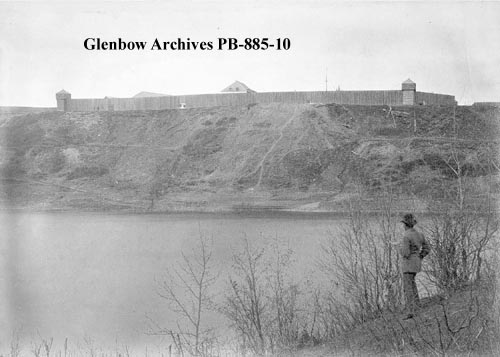
Person and Routledge, p. 71: «Edmonton became a city on November 7, 1904, by ordinance of the North West Territories Legislature…»
Person and Routledge, p. 72: «On a gaily decorated platform at the old Exhibition Grounds in Rossdale, Prime Minister and Lady Laurier, Governor-General Earl Grey, Lord Strathcona, Mayor K.W. Mackenzie and other distinguished visitors watched Hon. G.H.V. Bulyea as he signed the register of the crown to officially become the Lieutenant-Governor of the Province of Alberta. This was immediately followed by the reading of the King's [Edward VII] proclamation which inaugurated Alberta as a province at noon on September 1, 1905.»
Person and Routledge, p. 70: «When [Clifford] Sifton [minister of the interior] resigned in 1905, his successor was Frank Oliver of Edmonton. Oliver saw to it that when Alberta was proclaimed in 1905, Edmonton became the temporary capital. The following year, it was made the permanent capital.»
Fort Saskatchewan, 1905
Whilst the inauguration events and festivities were happening in Edmonton, the CNoR crews were hard at work 25 kilometres (16 mi) northeast of Edmonton at Fort Saskatchewan on the south bank of the North Saskatchewan River.
September 15, 1905
Grading and construction of the station are well underway:
November 8, 1905
Track laying through the town has commenced with many residents, young and old, witnessing the momentous event:
Fort Saskatchewan Bridge, 1905
Buck, p. 94: «Only one steel bridge was required between the Saskatchewan border and Edmonton — the crossing of the North Saskatchewan River at Fort Saskatchewan. Although the line had to make a jog to the north to reach Fort Saskatchewan, crossing the river at this point was advantageous, since the valley was narrower and shallower than at Edmonton. The site also permitted the construction of a temporary wooden trestle to enable track-laying crews to continue on to Edmonton while the steel bridge remained under construction.»
Buck, pp. 94: «The deck truss bridge, 874 feet long, was completed in 1906. The top of the truss carried the single-track main line, while a road deck sat on the bottom.»
Edmonton, 1905
Person and Routledge, p. 77: «Thousands of Edmontonians sought every possible vantage point from which to see the driving of the last spike on November 24, 1905 to commemorate the completion of the Canadian Northern Railway from Winnipeg to Edmonton. Somewhere in the center of this mass of cheering citizens, who also enjoyed a declared half-day holiday to mark the occasion, Lieutenant-Governor Bulyea drives the ceremonial silver spike at 2:15 in the afternoon.»«Donald Mann was in Edmonton to celebrate the coming of the CNoR.» :p.110 The silver spike was «… fashioned from a Mackenzie and Mann mine at Fort Steele in southeastern British Columbia.» :p.110 The station was located on the northwest corner of 101st Street and 104th Avenue [as per the city's revised street numbering scheme of 1913].
Person and Routledge, p. 77: «In his speech, after the cheering and engine whistling ceased, Bulyea recalled the vast difference between the three months it took the Red River carts to squeak across the prairie from Winnipeg and the twenty-eight hours it took the first C.N.R. special train to arrive for this historic occasion.»
Person and Routledge, p. 77: «After the reception and tea party held in the unfinished station following the driving of the silver spike, the construction of Edmonton's first C.N.R. station was hastened to completion by the year's end on the site where only ten years previously Indians had pitched their teepees and tethered their ponies. On November 30, 1905, the six-mile rail connection was made between the station and the Edmonton, Yukon and Pacific Railway which in turm crossed the Low Level Bridge to connext with the C.P.R. at Strathcona.»
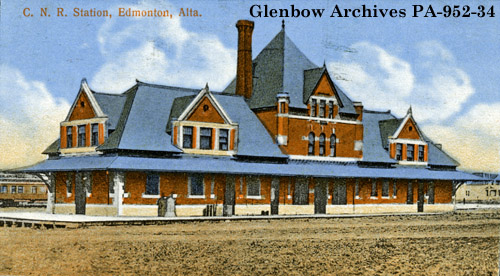
Vanterpool, p. 27: «The 118 by 33-foot station was faced with red brick and Tyndall Stone. It cost $30,000 when completed in February 1906.»
Person and Routledge, p. 77: «Although the city was now connected to both the east and west coasts of Canada, the first regular passenger train did not arrive in Edmonton until December 16, 1905.»
Epilogue
Vanterpool, p. 28: «The CNoR laid out an extensive divisional point yard in 1905-06... In addition to many storage tracks, it included a $15,000, 10-stall roundhouse on the south side of 105th Avenue at approximately 112th Street. A power house and machine shop wete attached to the east side. Elsewhere in the yard there were a 200-ton coaling plant, a water tank, an ice-house and other facilities.»
Person and Routledge, p. 77: «In July, 1909, the rival Grand Trunk Pacific Railway arrived and connected with the C.N.R. line in North Edmonton. While both companies shared this station, the G.T.P. company laid out its railyards, roundhouse and shops in Calder. The first G.T.P. train left Union Station for Wainwright on November 23, 1909, just three weeks after the company announced it had purchased a large block of land just east of the 101 Street station. The G.T.P. plans for their own station on this eastern site never materialized, so Union Station was kept busy servicing passengers and freight until a new C.N.R. station was opened on the original G.T.P. site in 1928. The first C.N.R. station was finally demolished in 1952, almost a half-century after the first train entered the city called "The Gateway to the North"»
Postscript
Vanterpool, p. 27: «The [track-laying] train was pulled/pushed by CNoR's No. 103 which subsequently became G-9-a No, 1046. It was a 4-6-0 "Tenwheeler" built by the Baldwin Locomotive Works and had 19 x 24 in. cylinders, 56 in. drivers and a boiler pressure of 180 psi for a haulage rating of 23%. It was donated to the City by the CNR in 1925 but was not looked after and become[sic] a derelict. It was returned to the CNR in 1937 and scrapped in April 1938.»
In August 1926, the locomotive made an appearance at an unspecified event. Given the date, it's very tempting to speculate that it was perhaps in conjunction with a ground-breaking ceremony for the new CNR station.
After more than a century, the piers of the Fort Saskatchewan bridge are still in situ :

The Baccarat Casino, now closed, occupies the old station's site:
Update February 6, 2020: The casino is being demolished and will become a parking lot for now.
In 2011, a great grandniece (if memory serves) of Lieutenant-Governor Bulyea donated the silver spike to the Royal Alberta Museum. As one who has had the priviledge of holding the spike, we can say that this small but hefty artifact heightens the history of the event that happened two blocks away.
Gallery
References
- Buck, G.H. (1997), From Summit to Sea: An Illustrated History of Railroads in British Columbia and Alberta, Fifth House Ltd., Calgary, ISBN 1-895618-94-0.
- Fleming, R.B. (1991), The Railway King of Canada, Sir William MacKenzie, 1849-1923, UBC Press, Vancouver, ISBN 0-7748-0382-7.
- Person, D. and Routledge, C. (1981), Edmonton, Portrait of a City, Reidmore Books, ISBN 0-919091-05-9.
- Vanterpool, A. (1997), The Railways of Edmonton, British Railway Modellers of North America, Calgary, Alberta, ISBN 0-919487-56-4.
- Wikipedia (2018), Canadian Northern Railway, last edited on 18 May 2018, at 11:19.
- Wikipedia (2018), Fort Saskatchewan, last edited on 9 May 2018, at 20:08.
- Wikipedia (2018), Hudson's Bay Company, last edited on 23 May 2018, at 14:32.
Last Updated October 04 2026, at 23:55:19 MDT ⚫ Visitor #